Friday, 24 June 2016

Pesta Kesenian BAli 2016 ( Karang Awak )

Om Swastiastu 

Diawali dengan liburan Sekolah di bulan june ini, di bali telah melangsungkan Pesta Kesenian Bali yang bertempat di  "Art Centre" Denpasar Bali. Pesta Kesenian Bali atau yang sering disingkat PKB yang ke 38 ini dimulai dari tanggal 11 June 2016 sampai dengan 09 July 2016 selama 30 hari penugh dengan mengusung tema " Karang Awak" yang artinya Mencintai Tanah Kelahiran.

Berikut adalah runtutan acara dari pembukaan PKB 11 June 2016 hingga selesai.


Semoga informasi ini bermanfaat untuk semuanya.

Salam Hangat 
Kompra Made 

Thursday, 27 August 2015

Sanur Village Festival 2015 "Dasa Warsa"


Warmest greeting from Kompra Made, come and join Sanur Village Festival

ABOUT SANUR VILLAGE FESTIVAL

Sanur Village Festival (SVF) is a community event founded by Sanur Development Foundation (YPS) which is a combination of several large-scale activities involving food festival, creative economy exhibition, various contests and competitions, art and cultural attractions, music as well as various types of environmentally-friendly activities.
The word Village Get a privileged place where we will not release shades rural a condensed in the sanur among global era and development of modern culture.
Aiming
  • Re-brand Sanur as one of the oldest tourist destination in Bali
  • Become the creative media in re-positioning the destination after the Bali Bombing both 1&2
  • Improving the economic in Sanur based on the tourism creative economics
  • Providing space to youth in exploring their creativities on culture, arts, musics and others
  • Alternative tourist attraction during their stay in Bali.
  • Re-positioning Sanur on the world tourism calendar of event.
Logo
SVF Logo is representative of the various elements that make the Sanur area becomes a very unique, including:
  • Traditional boat Jukung that is not exist in other places, where the Sanur Village Festival is expected to be a media to maintain and develop cultural and tourism-based economy.
  • Screen is representing the most popular water sport in Sanur, the wind surfing, and are hoping that Sanur Village Festival can be used as a tool to determine the direction of the Tourism Development.
A fun and cultural event
The words ‘a fun and cultural event’ is one of the logo’s component that describe the event is fun and based on a culture
As well as the existence of a typical festival, which aims to create a festive atmosphere with a variety of activities-rah rah party, but remains entrenched in the culture of Bali Sanur and in particular.
Tagline : “The New Spirit of Heritage
The tagline ‘The New Spirit of Heritage’ is expecting to give the soul of this event.
As known Sanur cultural and historical heritage having very unique and as old civilization in Bali even indonesia. For that we should keep honor and keep that which is inherited our fathers still everlastingly.
On the other side of the young generation challenged to give new vigor tweaks creativity and modern development could follow from the far left to keep the existence of an inheritance.

2015 Themed

“Dasa Warsa”
Nine years since it was first launched, Sanur Village Festival is a success as an independent tourism promotion effort that preserves and improves Sanur community ecology, economy, social cultural and creativity.
This success is generated by the support and close cooperation between three parties that have worked closely together during the decade of festival, Sanur’s community, government, and the private sector.
A decade of celebrations, the theme Dasa Warsa reflects how the festival has always been an icon people look forward to every yearThe 10 anniversary will be bigger and more festive with new and old programs loved by all the visitors.
Aside from the celebrations, One Decade of Sanur Village Festival should be a momentum to strengthen efforts in environment preservation, since many tourism activities tend to neglect ideals and philosophy practices by the Sanur community.
The first festival held back in 2006, which was a respond to the slowing of tourism post second Bali bombing (2005), still struggling from the first incident back in 2002. The following year, SVF II (2007) was launched with the theme “The New Spirit of Heritage” to give new spirit to the cultural ancestral heritage that preserved the coastal areas, environment and art creativity, and sustainable economy.
Afterwards the festival set themes in line with real development issues during the 9 years. Dasa Warsa is hoped to be Sanur starting point for expanding opportunities and facing future challenges. This destination competitiveness with its resources will encounter ASEAN economic society that demands consequence and high competency levels.
Sanur Village Festival among them will have cleaning the beach, reforestation, baby turtle release, surfing competition, fun run, jukung competition, food festival, fruit and ice carving, cultural parade, international kite festival, fishing tournament, body painting, photo competition, golf tournament, and musical performances. SME Bazaar and other creative products will be displayed during the Sanur Kreatif Expo.

The Venue

  • 2006 – 2008 : Cottage Inna Grand Bali Beach Sanur
  • 2009 : Pantai Mertasari
  • 2010 : Cottage Inna Grand Bali Beach Sanur
  • 2011 : Pantai MataharI Terbit
  • 2012 – 2015 : Maisonnette Area Inna Grand Bali Beach Sanur

Main Programs

  • Environment Activities
    • Beach clean up
    • Coral plantation
    • Tukik release
    • Extinction plantation
  • Festival Exhibition
    • Sanur Kreatif Expo
    • Cultural, Music and Art performances
    • Horticuloture
  • Cullinary
    • Food Festival
    • Food Heritage
  • Painting
    • Painting on the spot
    • Body Painting
    • SPRITES
  • Photography
    • Photo Exhibition
    • Photo Competition
  • Fun & Sport activities
    • International Sanur Kite Festival
    • Fun Games
    • Fun Run
    • Sanur Golf Tournament
    • Jukung Race
    • Fishing Tournament
    • Kids Zone
    • Village Cycling Tour

     Doc : http://www.sanurvillagefestival.com/about-sanur-village-festival/


    Best Regards
    Kompra Made
     

Thursday, 13 August 2015

New Hotel at Balian Beach

Heyy... Let me introduce the New hotel at Balian Beach Bali at Tabanan called Balian Paradise Resort ... Check this out :


  •   Facility

    Include Breakfast
    Swimming Pool
    Air Conditioned Bedroom
    Hot and Cold Water
    Television
    Bar and Restaurant
    Daily Cleaning

  •   Kailash Bar & Restaurant

    You can enjoy our delicious Indonesian and Western cuisine prepared daily in our kitchen at Kailash Bar & Restaurant


visit the website : www.balianparadiseresort.com


Online travel Agent : Booking.com Agoda.com, Expedia.com


Email : Balianparadiseresort@yahoo.com


Address : Jl. Pantai Balian, Br. Pengasahan, Surabrata, Tabanan – Bali
Phone : 081 353 296 669
Phone : 081 353 202 169

Best Regards
Kompra Made

Tuesday, 14 July 2015

Celebrating Galungan & Kuningan Days

 
Galungan is the most important feast for Balinese Hindus, a celebration to honor the creator of the universe (Ida Sang Hyang Widi) and the spirits of the honored ancestors.
The festival symbolizes the victory of good (Dharma) over evil (Adharma), and encourages the Balinese to show their gratitude to the creator and sainted ancestors.

Offerings to the Ancestors

Galungan occurs once in the 210-day cycle of the Balinese calendar, and marks the time of the year when the spirits of the ancestors are believed to visit the earth.
Balinese Hindus perform rituals that are meant to welcome and entertain these returning spirits.
The house compounds that make up the nucleus of Balinese society come alive with devotions offered by the families living within. Families offer bountiful sacrifices of food and flowers to the ancestral spirits, expressing gratitude and hopes for protection. These sacrifices are also offered at local temples, which are packed with devotees bringing their offerings.
The whole island sprouts tall bamboo poles called "penjor" - these are usually decorated with fruit, coconut leaves, and flowers, and set up on the right of every residence entrance. At each gate, you'll also find small bamboo altars set up especially for the holiday, each one bearing woven palm-leaf offerings for the spirits. 

Intensive Preparations

The preparations for Galungan begin several days before the actual feast day.
Three days before Galungan - "Penyekeban" - families begin their preparations for Galungan.
"Penyekeban" literally means "the day to cover up ", as this is the day when green bananas are covered up in huge clay pots to speed their ripening.
Two days before Galungan - "Penyajahan" - marks a time of introspection for Balinese, and more prosaically, a time to make the Balinese cakes known as jaja. These colored cakes made of fried rice dough are used in offerings and are also eaten specially on Galungan. This time of the year finds a glut of jaja in every village market.
A day before Galungan - "Penampahan", or slaughter day - Balinese slaughter the sacrificial animals that will go into the temple or altar offerings. Galungan is marked by the sudden surplus of traditional Balinese food, like lawar (a spicy pork and coconut sauce dish) and satay.
On Galungan day itself, Balinese devotees pray at the temples and make their offerings to the spirits. Women are seen carrying the offerings on their heads, while men bring palm fronds.
The day after Galungan, Balinese visit their kinfolk and closest friends.
The tenth day after Galungan - "Kuningan" - marks the end of Galungan, and is believed to be the day when the spirits ascend back to heaven. On this day, Balinese make special offerings of yellow rice.


Ngelawang - Dance of the Barong

During Galungan, a ceremony known as Ngelawang is performed in the villages. Ngelawang is an exorcism ceremony performed by a "barong" - a divine protector in the form of a mythical beast.
The barong is invited into houses as he makes his way through the village. His presence is meant to restore the balance of good and evil in a house. The residents of the house will pray before the dancing barong, who will afterwards give a piece of his fur as a keepsake.
After the barong pays a visit, it is important to make an offering of a canang sari containing money.

A Treat for the Senses

While the actual festivities are open to Balinese only, tourists who visit Bali during this holiday get an eyeful of the local color.
It isn't every day you see richly-dressed women crossing the street to make food offerings to the local temple - and there's something festive about the penjor swaying in the wind everywhere you look!
During Galungan, some local restaurants ride the rising demand for Balinese food by offering specials on all sorts of native dishes. This is a great time to try Balinese food for the first time!
On the downside, many places will be closed for Galungan, as their devout Balinese employees will likely be going to their respective villages to celebrate.
As the Balinese calendar follows a 210-day cycle, Galungan happens twice a year roughly every six months. The holiday is calculated to occur on the following dates:
  • May 21 - May 31, 2014
  • December 17 - December 27, 2014
  • July 15 - July 25, 2015
  • February 10 - February 20, 2016
  • September 7 - September 17, 2016
  • April 5 - April 15, 2017
  • November 1 - November 11, 2017
  • May 30 - June 9, 2018
  • December 26 - January 9, 2019
  • July 22 - August 3, 2019
  • February 19 - February 29, 2020
  • September 16 - September 26, 2020
  • April 14 - April 24, 2021
You might want to reserve a hotel in Bali early for these days, as holiday-goers from all over are making Galungan plans of their own!
By :  http://goseasia.about.com/od/eventsfestival1/a/galungan.htm 

Best Regards
Kompra Made


Tuesday, 19 May 2015

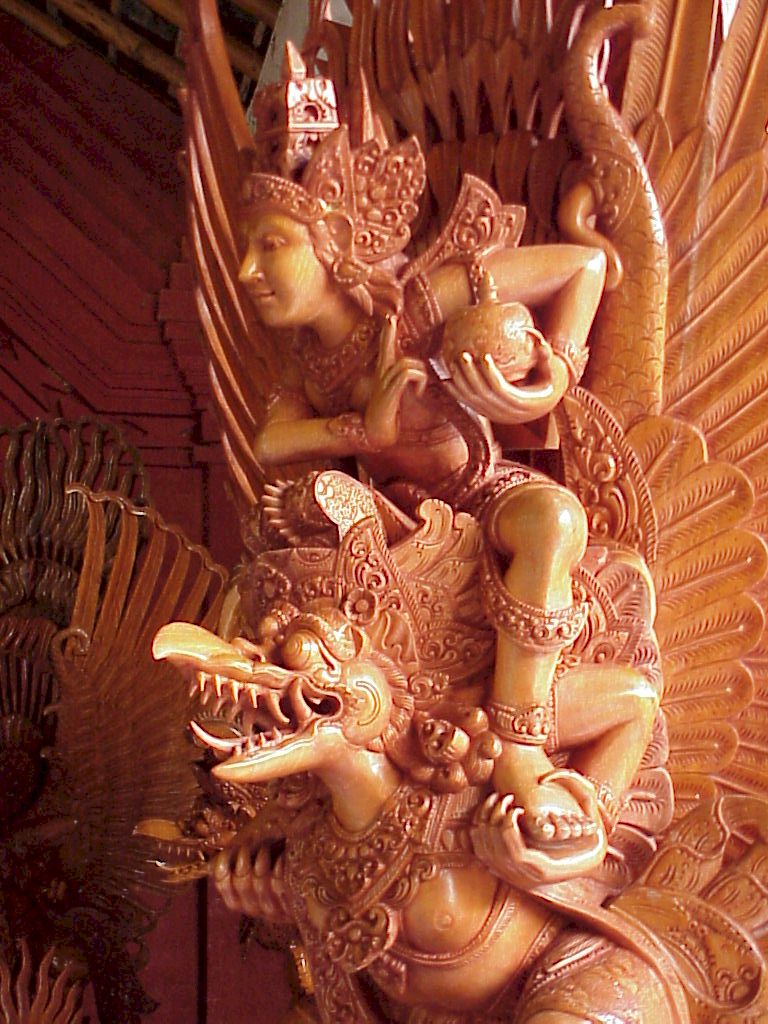
Ukiran Kayu Gianyar, Buah Tangan Eksklusif

 http://art-export.com/wood_carvings/wood_carving/bali_stlye/bali_style_2/14j.jpg
Gianyar dikenal sebagai daerah penghasil kerajinan dengan nilai seni tinggi. Satu di antaranya adalah kerajinan ukiran kayu tradisional yang reputasinya telah tersebar hingga ke mancanegara. Ukiran kayu asal Gianyar dikenal karena rancangan yang khas, detail ukiran yang rapi, dan jenis bahan baku yang berkualitas tinggi. Tak heran jika harga jualnya pun dapat menembus belasan dan bahkan puluhan juta.

Kerajinan ukiran kayu asal Gianyar memang bukan souvenir sembarangan. Proses pembuatan sebuah patung berkisar antara 1-4 bulan, melalui beberapa tahapan. Lamanya proses pengerjaan ini bergantung pada besarnya patung atau pahatan yang dibuat, jenis kayu, dan banyaknya detail ukiran dalam patung atau ukiran yang dibuat. Selain itu, karena sentuhan dari setiap seniman pematung memiliki kekhasan tersendiri, lama pengerjaan pahatan atau patung dari tiap seniman amat bervariasi.

Untuk sebuah patung kuda kayu dengan tinggi sekitar 2 meter dari kayu suar (trembesi), dibutuhkan waktu pengerjaan hingga 3,5 bulan. Dari rentang waktu tersebut, proses pengerjaan terbagi dalam beberapa tahapan, yang dimulai dengan pembuatan pahatan kasar (bakalan). Tahap selanjutnya adalah pembuatan detail dengan pisau serta pahat kecil. Setelah kedua tahap tersebut selesai, terakhir adalah tahap penghalusan dengan amplas.

Harga jual dari kerajinan ukiran kayu Gianyar amat bervariasi, bergantung siapa seniman yang mengerjakannya, detail ukiran, dan jenis bahannya. Karya dari setiap seniman memiliki nilai ekonomi yang berbeda karena kekhasan masing-masing seniman sulit ditiru oleh seniman lainnya. Detail ornamen yang ada dalam tiap ukiran atau patung pun amat khas dan memiliki tingkat kerumitan tersendiri, sehingga mempengaruhi harga jualnya. Sementara, jenis bahan akan berpengaruh terhadap nilai setiap patung dalam jangka waktu yang panjang.

Jenis kayu yang paling umum digunakan para perajin di Gianyar adalah kayu suar (trembesi) yang berasal dari Jawa dan Kalimantan. Jenis kayu lain yang juga digunakan diantaranya meranti, waru, sonokeling, ebony, dan bonggol jati yang juga berasal dari luar Bali. Bahan kayu lokal dari Bali adalah kayu panggal buaya (Zanthoxyllum rhetsa) yang berwarna putih dan bentawas (Wrightia pubescens R.Br) yang berdiameter kecil tapi panjang serta keras. Sedangkan, kayu seperti albasia jarang digunakan karena teksturnya yang lunak dan mudah lapuk sehingga tidak baik sebagai investasi jangka panjang. (Doc. by Indonesia Kaya)

Salam 
Kompra Made Driver ( Made Sujana)

Friday, 1 May 2015

Hari Saraswati

 
Hari Raya Saraswati yaitu hari Pawedalan Sang Hyang Aji Saraswati, jatuh pada tiap-tiap hari Saniscara Umanis wuku Watugunung. Pada hari itu kita umat Hindu merayakan hari yang penting itu. Terutama para pamong dan siswa-siswa khususnya, serta pengabdi-pengabdi ilmu pengetahuan pada umumnya.
Dalam legenda digambarkan bahwa Saraswati adalah Dewi/ lstri Brahma. Saraswati adalah Dewi pelindung/ pelimpah pengetahuan, kesadaran (widya), dan sastra. Berkat anugerah dewi Saraswati, kita menjadi manusia yang beradab dan berkebudayaan.
Dewi Saraswati digambarkan sebagai seorang wanita cantik bertangan empat, biasanya tangan- tangan tersebut memegang Genitri (tasbih) dan Kropak (lontar). Yang lain memegang Wina (alat musik / rebab) dan sekuntum bunga teratai. Di dekatnya biasanya terdapat burung merak dan undan (swan), yaitu burung besar serupa angsa (goose), tetapi dapat terbang tinggi .
Upacara pada hari Saraswati, pustaka-pustaka, lontar-lontar, buku-buku dan alat-alat tulis menulis yang mengandung ajaran atau berguna untuk ajaran-ajaran agama, kesusilaan dan sebagainya, dibersihkan, dikumpulkan dan diatur pada suatu tempat, di pura, di pemerajan atau di dalam bilik untuk diupacarai
Widhi widhana (bebanten = sesajen) terdiri dari peras daksina, bebanten dan sesayut Saraswati, rayunan putih kuning serta canang-canang, pasepan, tepung tawar, bunga, sesangku (samba = gelas), air suci bersih dan bija (beras) kuning.
Pemujaan / permohonan Tirtha Saraswati dilakukan mempergunakan bahan-bahan: air, bija, menyan astanggi dan bunga.
  • Ambil setangkai bunga, pujakan mantra: Om, puspa danta ya namah.
  • Sesudahnya dimasukkan kedalam sangku. Ambil menyan astanggi, dengan mantram "Om, agnir, jyotir, Om, dupam samar payami".
  • Kemudian masukkan ke dalam pedupaan (pasepan).
  • Ambil beras kuning dengan mantram : "Om, kung kumara wijaya Om phat".
  • Masukkan kedalam sesangku.
  • Setangkai bunga dipegang, memusti dengan anggaranasika, dengan mantram:

Mantra
Artinya
Om, Saraswati namostu bhyam Warade kama rupini Siddha rastu karaksami Siddhi bhawantu sadam. Om, Dewi Saraswati yang mulia dan maha indah,cantik dan maha mulia. Semoga kami dilindungi dengan sesempurna-sempurnanya. Semoga kami selalu dilimpahi kekuatan.
Om, Pranamya sarwa dewanca
para matma nama wanca.
rupa siddhi myaham.
Om, kami selalu bersedia menerima restuMu ya para Dewa dan Hyang Widhi, yang mempunyai tangan kuat. Saraswati yang berbadan suci mulia.
Om Padma patra wimalaksi
padma kesala warni
nityam nama Saraswat.
Om, teratai yang tak ternoda, Padma yang indah bercahaya. Dewi yang selalu indah bercahaya, kami selalu menjungjungMu Saraswati.

  • Sesudahnya bunga itu dimasukkan kedalam sangku. Sekian mantram permohonan tirta Saraswati. Kalau dengan mantram itu belum mungkin, maka dengan bahasa sendiripun tirta itu dapat dimohon, terutama dengan tujuan mohon kekuatan dan kebijaksanaan, kemampuan intelek, intuisi dan lain-lainnya.
  • Setangkai bunga diambil untuk memercikkan tirtha ke pustaka-pustaka dan banten-banten sebanyak 5 kali masing-masing dengan mantram:
    • Om, Saraswati sweta warna ya namah.
    • Om, Saraswati nila warna ya namah.
    • Om, Saraswati pita warna ya namah.
    • Om, Saraswati rakta warna ya namah.
    • Om, Saraswati wisma warna ya namah.
  • Kemudain dilakukan penghaturan (ngayaban) banten-banten kehadapan Sang Hyang Aji Saraswati
  • Selanjutnya melakukan persembahyangan 3 kali ditujukan ke hadapan :
    • Sang Hyang Widhi (dalam maniftestasinya sebagai Çiwa Raditya).
    • Sang Hyang Widhi (dalam manifestasinya sebagai Tri Purusa)
    • Dewi Saraswati.
  • Ucapkan mantra berikut:
Mantramnya
Artinya
Om, adityo sya parajyote rakte tejo namastute sweta pangkaja madyaste Baskara ya namo namah.
Om, rang ring sah Parama Çiwa Dityo ya nama swaha.
Om, Tuhan Hyang Surya maha bersinar-sinar merah yang utama. Putih Iaksana tunjung di tengah air, Çiwa Raditya yang mulia.
Om, Tuhan yang pada awal, tengah dan akhir selalu dipuja.
Om, Pancaksaram maha tirtham, Papakoti saha sranam Agadam bhawa sagare. Om, nama Çiwaya. Om, Pancaksara Iaksana tirtha yang suci. Jernih pelebur mala, beribu mala manusia olehnya. Hanyut olehnya ke laut lepas.
Om, Saraswati namostu bhyam,
Warade kama rupini,
Siddha rastu karaksami,
Siddhi bhawantume sadam.
Om Saraswati yang mulia indah, cantik dan maha mulia, semoga kami dilindungi sesempurna-sempurnanya, semoga selalu kami dilimpahi kekuatan.
   

Sesudah sembahyang dilakukan metirtha dengan cara-cara dan mantram-mantram sebagai berikut :


  • Meketis 3 kali dengan mantram:
    • Om, Budha maha pawitra ya namah.
    • Om, Dharma maha tirtha ya namah.
    • Om, Sanghyang maha toya ya namah.

  • Minum 3 kali dengan mantram:
    • Om, Brahma pawaka.
    • Om, Wisnu mrtta.
    • Om, Içwara Jnana.

  • Meraup 3 kali dengan mantram :
    • Om, Çiwa sampurna ya namah.
    • Om, Çiwa paripurna ya namah.
    • Om, Parama Çiwa suksma ya namah.

  • Terakhir melabahan Saraswati yaitu makan surudan Saraswati sekedarnya, dengan tujuan memohan agar diresapi oleh wiguna Saraswati
Setelah Saraswati puja selesai, biasanya dilakukan mesarnbang semadhi, yaitu semadhi ditempat yang suci di malam hari atau melakukan pembacaan lontar-lontar semalam suntuk dengan tujuan menernukan pencerahan Ida Hyang Saraswati
Puja astawa yang disiapkan ialah : Sesayut yoga sidhi beralas taledan dan alasnya daun sokasi berupa nasi putih daging guling, itik, raka-raka sampian kernbang payasan. Sesayut ini dihaturkan di atas tempat tidur, dipersembahkan ke hadapan Ida Sang Hyang Aji Saraswati.
Keesokan harinya dilaksanakan Banyu Pinaruh, yakni asuci laksana dipagi buta berkeramas dengan air kumkuman. Ke hadapan Hyang Saraswati dihaturkan ajuman kuning dan tamba inum. Tamba inum ini terdiri dari air cendana, beras putih dan bawang lalu diminum, sesudahnya bersantap nasi kuning garam, telur, disertai dengan puja mantram:
  • Om, Ang Çarira sampurna ya namah swaha.
Semua ini mengandung maksud, mengambil air yang berkhasiat pengetahuan.

Salam
Made Kompra ( Made Sujana)

Friday, 17 April 2015

Pura Besakih The Biggest Mother Temple at Bali

Rising majestically on the western slopes of Mount Agung, and referred to as the Mother Temple of Hindu Bali, is Pura Besakih, or the Besakih temple, covering  a vast area that offers  breathtaking mountain scenery surrounding this beautiful and artistic temple complex.
Facing Mt. Agung’s highest peak, believed to be the abode of the gods, and located at an altitude of 900 meters, Pura Besakih is built in the village of Besakih, in the eastern part of Bali. The name Besakih comes from the word “Basuki”, derived from the word “Wasuki” which means Salvation in the classical Sanskrit language. Whereas, in the Samudramanthana mythology, the same name “Besuki” in fact refers to the Dragon-God “Naga Besukian”, who inhabited Gunung Agung, the main volcano in Bali.
This grand temple complex has been revered as a holy place since ancient times. The first recorded mention of its existence comes from an inscription dating back to 1007 AD. It is known that since the 15th century Besakih was regarded as the central temple of Hinduism in Bali.
 Pura Penataran Agung, or the “Great Temple of State” is the center of the temple complex and is is Bali’s main place of worship, a complex comprising twenty-two temples on six rising terraces set on parallel ridges.
 This complex expresses the essential belief of the Balinese known as Tri Hita Kirana, meaning that life on earth must be lived and kept in balance and harmony between man and God, man and society and his fellow human beings, and man and his natural environment.
During a full moon, Balinese and pilgrims throng to the temple. During the festival of Odalan, the temple is most elaborately decorated. Odalan is celebrated on every 210th day.
Away from the loud parties of Kuta Beach, leaving the thrilling waves of Uluwatu behind and the modern facilities of Nusa Dua, then traveling beyond enchanting  Ubud, a visit to Pura Besakih is truly a spiritual experience into the heart of Balinese religious and cultural life.

Best Regards
Kompra Made (Made Sujana)